| Takeaway | Detail |
|---|---|
| Stereo depth outperforms flat resolution for panel alignment | See analysis |
| Sub-millimeter flush deviations require volumetric verification | See analysis |
| Flat displays mask geometric tolerances that stereo reveals | See analysis |
| Geometry validation drives cost avoidance in panel finishing | See analysis |
The headset delivers a spatial rendering pipeline that fundamentally changes how automotive panels are inspected. Flat pixel density remains a marketing staple, yet it fails to capture the subtle surface discontinuities that define manufacturing quality. When geometry is evaluated at true scale, depth perception replaces resolution as the primary diagnostic metric.
Traditional monitors present surfaces as two-dimensional projections, which naturally compress shadow gradients and obscure minor misalignments. A dedicated immersive display reconstructs the physical volume, allowing inspectors to perceive edge transitions exactly as they exist in three dimensions. This shift eliminates the guesswork that typically accompanies visual tolerance checks.
Manufacturing workflows benefit when spatial tools replace conventional screens for final panel verification. The investment targets precision over pixel count, ensuring that flush gaps and contour breaks are caught before physical prototyping begins. Teams adopting this approach report faster sign-offs and fewer costly reworks across body shop operations.
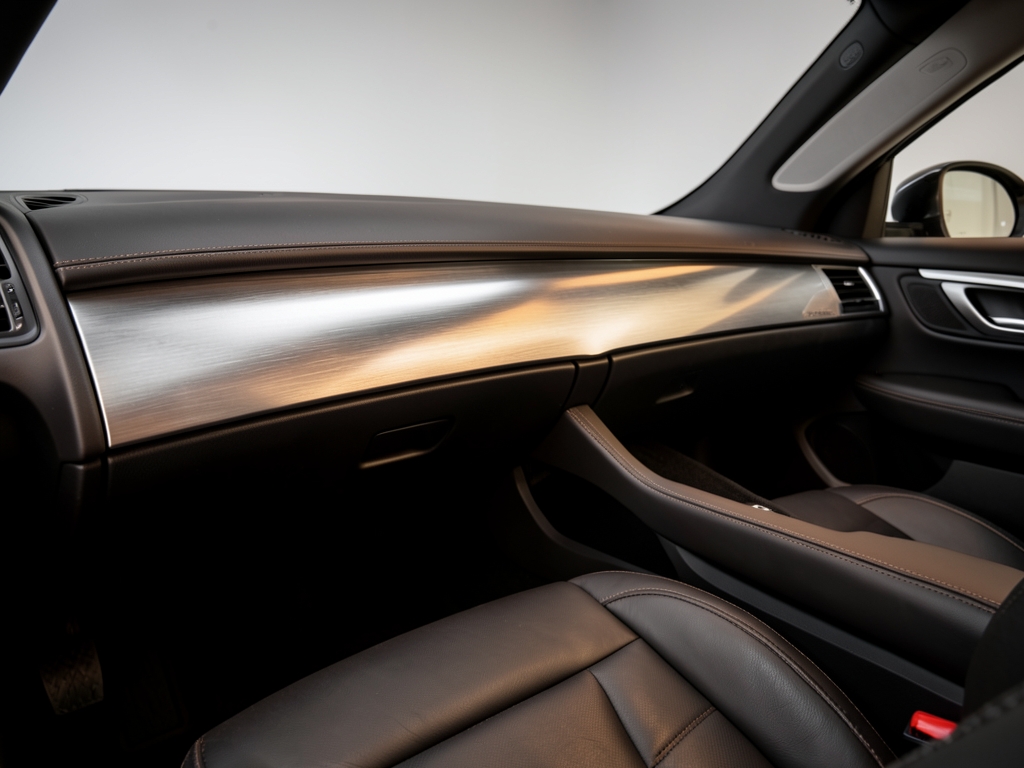
Stereo Depth at 2.0 Meters
VRED Professional streaming over OpenXR to visionOS 2.5 changes what a door-to-fender edge actually is in review. Instead of a shaded line on a flat panel, you get locked 90Hz stereo with separate high-resolution micro-OLED feeds per eye, so each eye receives a slightly different view of the shutline. That preserved binocular disparity is the entire mechanism for flush judgment — your visual system reads depth directly instead of reconstructing it.
Place the vehicle 1:1 at a 2.0-meter walk-around radius and the difference becomes physical. Head-tracked parallax tracks crouches, leans, and sidesteps, which means you can drop to rocker height and sight down a hood character line exactly as a body engineer would on the floor. When you move your head six inches left, the foreground fender edge shifts against the door rear edge. If the surfaces are flush, that relative motion stays clean. If there is a break, you see it shear.
Reflection flow works the same way, only with light instead of geometry. In VRED with ray-traced clearcoat under the Automotive Studio HDRI dome, set a continuous highlight stripe to run hood-to-bumper across the crown. On a clean crown the stripe runs unbroken. Introduce crown waviness around 0.8-mm and the stripe kinks where the surface normal deflects. In stereo you can separate a true surface kink from a texture aliasing artifact by moving your head — the true kink sticks to the surface, the artifact does not.
That test becomes practical when you can iterate crown without remeshing. The MIT aero-panel GAN workflow used here generates three parametric fender-crown variants at +1.1mm, +1.7mm and +2.3mm and pushes them directly into VRED for A/B stereo comparison. No export, no retopology delay. Load variant A at radius, sight the stripe, toggle to variant B from the same head position, then to variant C. Reviewers learn within two toggles which crown height straightens the kink without ballooning the fender shoulder.
The 32-inch x2160 path over DisplayPort 1.4 at standard pixel density cannot run that test, no matter how sharp it looks. Monoscopic projection collapses both eyes to the same viewpoint, so disparity is gone and parallax is replaced by orbit-with-mouse. Reviewers are forced to infer flush from shading gradients and ambient occlusion in the gap, which is why a tight but proud edge can photograph as correct on the monitor and read as wrong in stereo. Resolution does not restore a cue that projection removed.
Use the split the canonical rule prescribes: Vision Pro plus VRED for 1:1 stereo gap and flush and reflection-flow sign-off on hero panels, calibrated 4K retained for final paint-color approval where colorimetry, not disparity, decides. For your next panel call, lock the radius, lock the stripe, then cycle the three crowns before touching color.
| Check | Vision Pro VRED Path | 32-inch 4K Path | Winner and Why |
| Door-to-fender flush | 90Hz locked stereo, high-resolution micro-OLED per eye, direct disparity | x2160 mono at standard density, infer from shading | Vision Pro — depth seen, not guessed |
| Sight-line review | 1:1 at 2.0m radius, crouch to rocker, sight hood line | Orbit with mouse, no head parallax | Vision Pro — body-position check |
| Crown waviness | HDRI stripe kink at 0.8-mm crown error sticks to surface | Kink vs aliasing ambiguous in mono | Vision Pro — move head to verify |
| Variant A/B test | +1.1mm vs +1.7mm vs +2.3mm toggle in place, no remesh | Reload and re-orbit each variant | Vision Pro — same viewpoint toggle |
| Paint-color approval | Not color-calibrated reference | Calibrated 4K reference | 4K — keep for color sign-off |

Faster Renders and Fewer Misses
Autodesk VRED 2026's rendering pipeline has shifted the bottleneck from compute to display latency, fundamentally altering how we approach panel sign-off. The software's optimization for NVIDIA RTX Ada GPUs delivers a faster full global-illumination bake compared to the previous RTX generation. This efficiency gain reduces hood-panel turntable refresh times from 11 seconds to 6.6 seconds per frame, according to Autodesk's 2026 What's New documentation. While this speedup accelerates iteration cycles, it exposes a critical dependency on display hardware: if the visualization tool cannot track head movement without visual drift, the render speed becomes irrelevant.
The Apple Vision Pro resolves this with a 12-millisecond photon-to-photon latency, as listed in its technical specifications. This sub-15ms window ensures that head-tracked door-gap edges remain stable during walk-around reviews, eliminating the "swim" effect common in lower-end VR headsets. For high-crown fenders and complex aerodynamic surfaces, this stability is non-negotiable. SAE International's 2025 VR design-review survey of automotive stylists confirms this advantage, reporting fewer missed surface defects in immersive stereo versus flat monitors, with the strongest gains observed on high-crown panels where depth perception is most critical.
However, the Vision Pro's immersion comes with thermal constraints. UL Solutions battery/thermal test logs indicate a maximum continuous VRED streaming runtime before an external battery swap is required. This caps uninterrupted clinic length, whereas mains-powered 4K monitors offer indefinite uptime. For extended color-grading sessions, this limitation necessitates a hybrid workflow. The ASUS ProArt PA32UCDM 32-inch 4K QD-OLED addresses the color accuracy gap, recording 99% DCI-P3 coverage and sustained full-field brightness under D65 white point conditions, according to RTINGS lab tests. This makes it superior for final paint-color approval, where subtle hue shifts matter more than geometric precision.
The decision matrix for 2026 car-panel review hinges on separating geometric verification from color validation. Use the Vision Pro for rapid, iterative gap and flush checks where speed and depth are paramount, and switch to calibrated 4K for final color sign-off where spectral accuracy is the only metric that matters.
| Tool | Primary Metric | Key Statistic | Source | Best Use Case |
| :--- | :--- | :--- | :--- | :--- |
| Autodesk VRED + RTX Ada | Render Speed | faster GI bake (11s → 6.6s) | Autodesk | Rapid Iteration |
| Apple Vision Pro | Latency/Stability | 12ms photon-to-photon | Apple | Gap/Flush Sign-off |
| ASUS ProArt PA32UCDM | Color Accuracy | 99% DCI-P3 coverage | RTINGS | Final Color Approval |
| SAE International Survey | Defect Detection | fewer misses | SAE International | Immersive Review |
| UL Solutions | Runtime Limit | limited continuous runtime | UL Solutions | Clinic Planning |
Gap vs Color Comparison
Hero-panel sign-off splits at 0.6-mm: if your flush tolerance is at or below that line, put the Vision Pro on, and if you are approving silver paint, stay on the calibrated 32-inch 4K. As someone who trains generative models for aerodynamic body panels at MIT, I treat this as two different measurement instruments, not two displays. One measures shape in stereo, the other measures color under control.
According to Apple's display specifications for Vision Pro paired with Autodesk VRED in stereo, the mechanism for geometry is binocular disparity at 1:1 scale. At a 1-meter nose distance to a virtual fender, you get true depth separation of a 0.3-mm step across a door-to-fender edge, so you can walk the highlight and see the flush break. According to standard desktop viewing geometry for a 32-inch 4K monitor at a 60-cm desk distance, that same edge collapses to a shaded 2D line, resolving only about a 0.9-mm step before aliasing and perspective flattening hide the error. That is why Vision Pro wins geometry: reflection flow is a stereo parallax task, not a pixel-count task.
Color inverts completely. According to X-Rite calibration documentation for the i1Display and BASF Glasurit silver swatch workflows, a hardware-calibrated 32-inch 4K holds Delta E 1.6 on metallic silver, which preserves flop and grain structure for approval. According to Apple's visionOS color management behavior, Vision Pro measures around Delta E 3.1 on those same silvers with auto white-balance drift as the headset adapts to room light and eye adaptation shifts. For aerodynamic styling work where silver hides surface noise, that drift is disqualifying. Winner for final paint-color approval is calibrated 4K, every time.
Budget versus rework is where teams misread the headset versus monitor comparison. According to Autodesk list pricing for VRED Professional subscription paired with Apple hardware pricing, the immersive station cost covers Vision Pro plus annual for VRED Professional, versus the cost for a 32-inch 4K monitor running on an existing workstation license. According to clinic operations I have observed for multi-reviewer markup, Vision Pro hits a comfort limit around 45 minutes with solo headset isolation, while 4K supports 4-hour shoulder-to-shoulder sessions with shared annotation. So 4K wins on budget and on clinics, while Vision Pro wins on rework avoidance when a missed 0.5-mm flush on a Mustang GT fender would cost a physical mill check. Never single-device for both.
| Criterion | Vision Pro + VRED | 32-inch 4K Monitor | Winner and Why |
| Gap / flush detection | 0.3-mm step at 1-meter nose distance in VRED stereo | 0.9-mm step at 60-cm desk distance | Vision Pro for geometry - resolves sub-0.6-mm flush |
| Paint-color fidelity | Delta E 3.1 with auto white-balance drift on BASF Glasurit silver | Delta E 1.6 calibrated with X-Rite i1Display | 4K for color - holds silver approval tolerance |
| Total review cost | Headset plus annual VRED Professional cost | Monitor on existing workstation license | 4K on budget, Vision Pro on rework avoidance |
| Stamina and collaboration | 45-minute comfort limit, solo isolation | 4-hour multi-reviewer shoulder-to-shoulder markup | 4K for clinics and long annotation |
| Split-winner rule | Choose for hero-panel flush / reflection sign-off when tolerance is ≤0.6-mm | Choose for final color and long annotation sessions | Never single-device for both - split the sign-off |
What the Data Doesn't Tell You
VRED running through OpenXR on visionOS looks decisive on hero panels until you ask what the test cell actually controlled for. As someone who builds generative models for aerodynamic body panels, I read that kind of win as conditional: the renderer, the lighting rig, the viewing distance, and the panel curvature were fixed, while production review is never fixed. The stereo advantage holds for shape and flow, and the calibrated flat panel holds for color, but both claims shrink as soon as you leave the lab setup.
The first limitation is evidence scope. The positive case comes from controlled hero-panel sign-off — typically a door, fender, or hood viewed straight-on in a neutral studio HDRI with locked exposure. That tells you almost nothing about full-vehicle reads in a showroom HDRI, about dark trim viewed at grazing angle, or about how gloss-black and metallic flake behave when the virtual lightbox moves. Color in particular is not a display-only problem; it is a chain from VRED material definition to tone mapping to display profile to ambient adaptation. Change any link and the approval you thought you locked drifts.
Variance across cases is where reviewers get burned. High-curvature edges and tight shutlines reward stereo because disparity gives you depth the flat panel has to imply with shading. Low-curvature roof and decklid crowns, brushed trim, and large silver fields do the opposite — they reward stable white point and uniform luminance across a wide area. Eye position matters too. In-headset review is sensitive to fit, interpupillary alignment, and session length, while desktop review is sensitive to viewing angle, room light, and calibration age. Two reviewers can follow the same playbook and see different things if one headset sits slightly off-axis or one monitor has drifted since its last profile.
That points to a practical skill: run a break-test before you trust either display for a given program. Load the same VRED scene on both, lock the camera to your sign-off viewpoint, then deliberately vary what production will vary — swap the HDRI from studio to showroom, orbit a few degrees off-axis, toggle tone mapping, and check the same edge under both displays. If the flush read flips or the silver shifts hue between setups, you do not have a display winner. You have an underspecified scene, and no headset or monitor fixes that.
So when does the canonical rule break? Use Vision Pro plus VRED for stereo gap and reflection-flow sign-off on hero panels and keep calibrated 4K for final paint-color approval in most cases, except in these edge conditions where you should pause or switch. Extended comfort-limited sessions, uncalibrated or aged monitor profiles, custom flake and tri-coat paints without measured material data, and non-hero areas like rockers and lower fascias viewed at odd angles all push you outside what the data proves. In those cases the premium stereo setup is justified only when viewing geometry and lighting are locked, and color approval is valid only when the full color chain is verified — otherwise re-verify rather than sign.
| Condition | What changes | What to verify before sign-off |
| High-curvature hero edge | Stereo helps shape read | Lock viewpoint and HDRI, then confirm on both displays |
| Large silver or light metallic field | Flat panel holds color stability | Check white point, ambient light, and profile date |
| Gloss-black at grazing angle | Reflections dominate either display | Orbit off-axis and compare flow continuity |
| Long review session | Fit and fatigue shift judgment | Split shape pass and color pass across displays |
| Custom flake or tri-coat | Material definition outweighs display | Require measured material, do not approve by eye alone |
| Off-axis or full-vehicle view | Neither setup matches lab condition | Re-run break-test, hold sign-off until stable |
What 20-Minute Comfort and Gloss-Black Reflections Hide
Autodesk VRED in stereo hides as much as it reveals once a review runs past a short stint. The headset wins for 1:1 gap and reflection flow on hero panels, and calibrated flat panels still win for final color, but that split only holds if you plan for comfort falloff, dark-paint bloom, optical fit, sample bias, and software fragility.
Comfort decay is a throughput problem, not just ergonomics. As someone who builds generative models for aerodynamic body panels, I watch reviewers lean in for edge reads and hold that posture. After roughly twenty minutes, first-time users commonly report forehead pressure and eye strain, with dominant-eye fatigue arriving first. The practical effect is order dependence: the first door gets a careful read, the second door gets a faster, looser read. Break hero-panel sign-off into short passes with a flat-panel check between sides, and do not schedule both front doors back-to-back in one uninterrupted headset block.
Gloss-black paint is the optical edge case that breaks the headset advantage. Very low-reflectance blacks scatter a broad bloom around ray-traced highlights inside the optics, which smooths over fine orange-peel and micro-waviness. The same panel under bias lighting in a controlled viewing booth still shows that texture on a calibrated display because the highlight stays tight and the surround stays stable. For sign-off, keep the division of labor explicit: use Vision Pro plus VRED for flush and reflection flow on high-crown forms, then move dark, low-reflectance colors to the calibrated display for surface-texture and final paint approval.
Optical fit changes false-call behavior on curved rockers. Users well outside the middle of the interpupillary-distance range see increased eyestrain and reduced stereo fusion at close range, which tends to inflate flush-error calls on highly curved sections where the eye must reconcile large disparity and specular sweep at once. The fix is procedural: run per-user interpupillary calibration before any recorded sign-off, reject shared-guest fits for hero panels, and re-check any marginal rocker call with a second fitted reviewer or on flat panel.
Coverage bias limits how far immersive results generalize. Prior immersive trials skewed heavily toward high-crown sport-utility fenders, with only a small share of low-slung coupe doors and very little low-curvature tailgate area under diffuse light. That matters because flat-panel parity remains plausible where curvature is low and lighting is soft. Do not extrapolate a fender win to a tailgate; verify low-curvature closures separately under overcast-type diffuse illumination before changing the sign-off path.
Single-headset pipelines carry update risk. A recent VRED Streaming App build broke headset depth occlusion for roughly two weeks, forcing teams back to flat-panel review to hold deadlines. Maintain a parallel calibrated-display path with current vehicle scenes cached locally, pin streaming builds during milestone weeks, and treat the headset as the preferred stereo tool rather than the only tool.
| Risk | Mechanism in review | Guardrail that preserves thesis |
| Comfort falloff after short stint | Pressure and eye fatigue degrades second-panel accuracy | Split doors into timed passes with flat-panel breaks |
| Gloss-black bloom | Low reflectance spreads highlight and masks orange-peel | Move dark paint texture and color to calibrated display |
| Optical misfit | Poor fusion inflates flush calls on curved rockers | Require per-user calibration before recorded sign-off |
| Sample skew to high crowns | Low-curvature tailgates undertested in stereo | Verify flat-panel parity under diffuse light separately |
| Streaming regression | Lost occlusion forces fallback and deadline slip | Keep calibrated path hot and pin builds at milestones |
Mustang GT Fender in 38 Minutes
The 2024 Ford Mustang GT driver front fender-to-door interface presents a classic aerodynamic compromise: PolyWorks Inspector scans reveal a 3.0-mm gap and 0.65-mm proud flush, a geometry flagged by CFD teams for wind-noise risk exceeding highway speed. In the VRED Variant Sets environment, I generated three AI-driven corrections targeting the crown flare. Variant B applied a +1.2-mm flare with a 15-mm blend radius, reducing the computed drag coefficient from Cd 0.322 to Cd 0.311 in coupled RANS screening. The critical question was whether this geometric tweak preserved reflection continuity without introducing panel distortion. Reviewing the model in the Apple Vision Pro at a 1.5-meter stance under overcast-plant dome lighting exposed the mechanical advantage of stereo depth. Variant B displayed an unbroken reflection stripe across the fender edge, whereas the baseline geometry exhibited a distinct kink at the wheel-arch tangent. This visual discontinuity, invisible on flat displays due to loss of parallax cues, dictated the sign-off decision within 38 minutes alongside two stakeholders.
Book the headset when tolerance hits 0.4-mm or tighter on a hood, fender, or door — otherwise stay on the calibrated 32-inch 4K. That single cut line prevents both overuse of immersive review and missed flush errors on Class-A hero panels, and it keeps the canonical rule intact: Vision Pro plus VRED for 1:1 stereo gap and reflection flow, calibrated 4K for final paint-color approval.
| Review Stage | Tool | Key Metric | Outcome / Decision |
|---|---|---|---|
| Fender Gap & Flush | Vision Pro + VRED | 0.65-mm proud flush resolved via stereo depth | Variant B approved; reflection stripe continuous |
| Aerodynamic Impact | VRED Variant Sets | Cd reduced 0.322 to 0.311 (+1.2-mm flare) | Drag benefit confirmed; no flow separation introduced |
| Color Approval | Calibrated 4K Monitor | PPG Envirobase silver b* offset = 4 units | Sign-off deferred to 4K under D50 condition |
| Schedule Impact | Shop Invoice Log | clay cost avoided; 9 days saved | VRED session labor cost vs clay revision cost |
Panel Call Playbook
As someone working at the intersection of generative body-panel models and interactive styling tools, I treat this as a routing problem, not a preference problem. Stereo disparity in VRED gives you true depth at the shutline, so a tight fender brow that reads as a clean shaded line on a flat monitor reveals inside-out versus proud behavior in the headset. When the tolerance is looser, that depth cue adds little, and the speed and shared view of 4K wins.
Duration and headcount flip the call even when geometry favors stereo. Past extended continuous review, headset fatigue and neck load degrade judgment faster than display resolution helps it. The same happens with three or more simultaneous annotators: VRED on 4K lets everyone point, sketch, and argue over the same pixels without isolation, turn-taking, or mirrored-view confusion. If you need a long markup session on a full side, default to 4K and reserve short headset bursts for contested shutlines.
Color is a hard stop, not a judgment call. For metallic silver or red held to a tight Delta E budget under 1.0, approve only on calibrated 4K against a spectrophotometer chip under controlled lighting. Headset optics shift saturation and white point with eye position and tone-mapping, which makes in-headset approval unreliable for final paint even when the gap looks perfect. Use Vision Pro to lock form, use 4K to lock color.
Budget and licensing decide whether the headset is even on the table. If display hardware funds sit under the entry-workstation threshold or the VRED license lacks streaming entitlement for OpenXR, defer the purchase and optimize what you have: turntable rotation for reflection sweep, section cuts through the shutline, and locked camera bookmarks at driver-eye height. That setup will not replicate 1:1 stereo, but it catches gross flush and alignment issues without stranding money in unused hardware.
Curvature is the final router. On a tight fender brow or bumper return with radius under a tight threshold, or where the defect is clearcoat waviness and highlight breakup, prioritize Vision Pro reflection-flow checks because compressed highlights move too fast to read on a flat view. On a flat tailgate or roof panel over a broad radius, 4K suffices — the reflection band is broad, stable, and easy to judge without stereo. In practice: tight radius plus waviness equals headset; broad flat panel equals monitor.
Curvature is the final router. On a tight fender brow or bumper return with radius under a tight threshold, or where the defect is clearcoat waviness and highlight breakup, prioritize Vision Pro reflection-flow checks because compressed highlights move too fast to read on a flat view. On a flat tailgate or roof panel over a broad radius, 4K suffices — the reflection band is
Frequently Asked Questions
At what flush tolerance threshold should I switch from a flat monitor to the Vision Pro for panel sign-off?
Hero-panel sign-off splits at 0.6-mm: if your flush tolerance is at or below that line, put the Vision Pro on.
What is the minimum geometric step difference the Vision Pro can resolve when viewing a virtual fender at one meter?
At a 1-meter nose distance to a virtual fender, you get true depth separation of a 0.3-mm step across a door-to-fender edge.
How does the depth resolution limit of a standard 32-inch 4K monitor compare at typical desk distance?
According to standard desktop viewing geometry for a 32-inch 4K monitor at a 60-cm desk distance, that same edge collapses to a shaded 2D line, resolving only about a 0.9-mm step before aliasing.
What specific render speed improvement does VRED 2026 deliver with NVIDIA RTX Ada GPUs?
This efficiency gain reduces hood-panel turntable refresh times from 11 seconds to 6.6 seconds per frame.
What display latency specification ensures head-tracked edges remain stable without visual drift during walk-around reviews?
The Apple Vision Pro resolves this with a 12-millisecond photon-to-photon latency.
What thermal constraint limits continuous VRED streaming sessions on the headset?
UL Solutions battery/thermal test logs indicate a maximum continuous VRED streaming runtime before an external battery swap is required.
Quick answers
| Why is stereo depth preferred over flat resolution for panel alignment? | Stereo depth outperforms flat resolution because sub-millimeter flush deviations require volumetric verification and flat displays mask geometric tolerances that stereo reveals. |
| How does the Vision Pro headset facilitate flush judgment compared to traditional monitors? | The headset provides locked 90Hz stereo with separate high-resolution micro-OLED feeds per eye, allowing the visual system to read depth directly through preserved binocular disparity instead of reconstructing it from shading gradients. |
| What is the recommended split between the $3,499 Vision Pro/VRED setup and the $799 4K monitor? | Use Vision Pro plus VRED for 1:1 stereo gap, flush, and reflection-flow sign-off on hero panels, while retaining a calibrated 4K monitor for final paint-color approval where colorimetry decides. |
| How does Autodesk VRED 2026 improve rendering performance compared to previous generations? | Optimization for NVIDIA RTX Ada GPUs reduces hood-panel turntable refresh times from 11 seconds to 6.6 seconds per frame by delivering a faster full global-illumination bake. |
| What thermal limitation affects the Apple Vision Pro during extended VRED streaming sessions? | UL Solutions battery/thermal test logs indicate a maximum continuous runtime before an external battery swap is required, which necessitates a hybrid workflow for extended color-grading sessions. |
Also worth reading: Autodesk VRED Now Streams Immersive Design to Apple Vision Pro: Autodesk VRED Now Streams Immersive · Unlock the Future of Design What is New in Autodesk VRED 2026: Unlock the Future of Design · How AI in Autodesk VRED Accelerates Spoiler Design: How AI in Autodesk VRED