
$31,000 — the tampering exposure this guide pegs for a Super Duty EGR delete under Clean Air Act §203 — buys a lot of diesel. Spread across the maximum realistic fuel savings an EGR delete actually delivers on a 6.7L Power Stroke, that penalty equals decades of driving on the difference. Federal schedules make the stakes explicit: individual owners and mechanics face up to $5,911 per incident, while manufacturers and dealers reach $59,114 per vehicle once inflation adjustments apply.
The delete community's favorite number — 2 to 3 mpg — survives dyno scrutiny only until regeneration enters the ledger. A deleted truck skips the extra injection events that burn fuel to clean a diesel particulate filter, so the dashboard books gains that were never combustion efficiency. Thermodynamic surrogate modeling of the 6.7L shows steady-state brake-specific fuel consumption moving less than 1% when the EGR system is blocked.
That is the entire trade: a five-figure federal penalty for a rounding error an owner can pursue legally. Disabling EGR sits on EPA's named tampering list beside gutted particulate filters and defeat-device tuning — the conduct behind Cobb Tuning's $2.9 million penalty and an Idaho tuner's $1 million in criminal fines. Compliant maintenance and calibration recover most of what deletion promised, minus the per-violation arithmetic.
The High-Dilution Engine
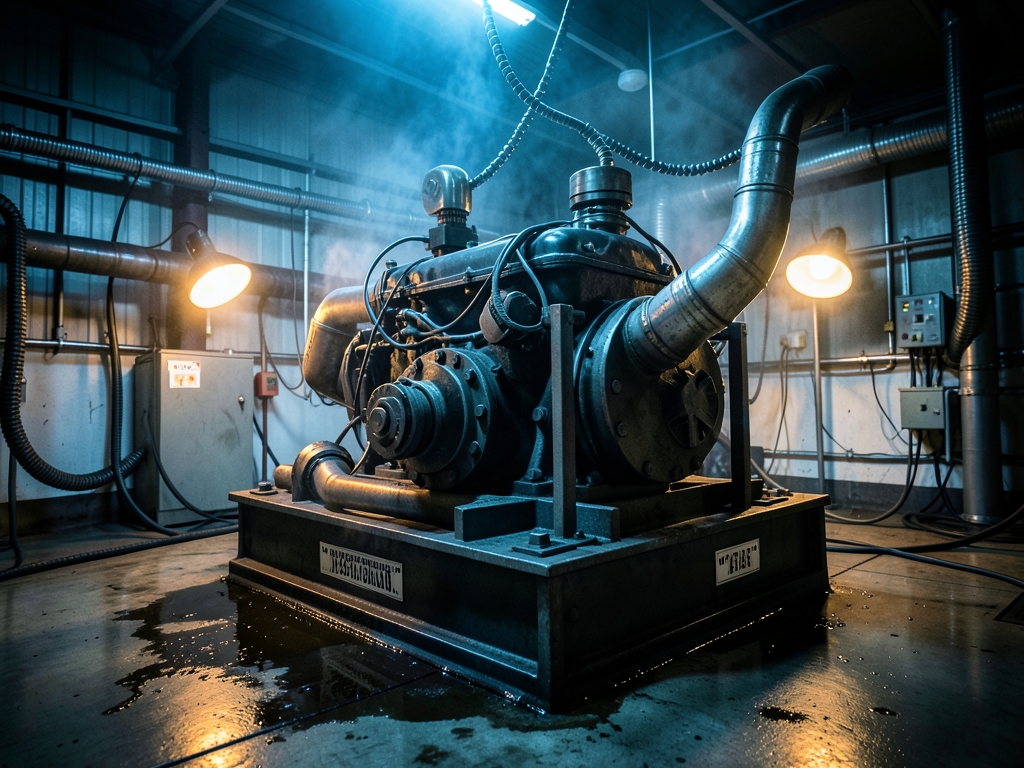
At a steady 65 mph, a stock 6.7L Power Stroke routes a large share of its cylinder charge through the EGR valve instead of the air filter. That single fact explains both why the delete folklore exists and why it disappoints. Recirculated exhaust is inert ballast: it cuts peak combustion temperature, and with it NOx by roughly half, but swapping it for fresh air changes exactly one physical variable — intake oxygen density. Every horsepower and every MPG claim ever attached to an EGR delete has to flow through that single variable, and at highway load it is worth less than 1% of brake-specific fuel consumption.
The reason the gain is structurally small: a gasoline engine suffers real pumping losses through its throttle, so deleting EGR recovers some. A diesel has no throttle plate. The EGR valve is not a restriction in the breathing path at cruise — it is a metering device feeding inert gas into an otherwise unthrottled intake. Raise oxygen density and combustion runs marginally hotter and faster, but brake-specific fuel consumption barely moves.
The measurable money sits on the other side of the ledger. The DPF calls an active regeneration roughly every 300–500 miles and post-injects about one extra quart of fuel per event to drive soot burning past 550–600°C. Run that arithmetic: a quart every few hundred miles works out to a few tenths of an MPG at steady highway cadence. In severe service — cold short trips — the interval compresses well below 300 miles, which is precisely where owner fuel logs show larger gains clustering. Instrumented fill-up records land between 0.5 and 1.5 MPG, nearly all of it regeneration elimination, nowhere near the 2–3 MPG the forums promise. Nothing in that mechanism requires unbolted hardware, which is why maintenance and compliant tuning chase the same pennies legally.
The turbo is why no legitimate kit ships without a retune. The Garrett GT37-series variable-geometry turbo on the 6.7L carries a vane schedule calibrated against EGR-diluted exhaust mass flow. Delete the dilution untuned and the vanes operate off their mapped points — boost overshoots, hunts, and can destabilize at light load. Even a competent retune leaves the vane map outside its validated envelope.
You can verify the whole argument with a 1-D thermodynamic surrogate — ideal-gas mixing on the intake charge, standard diesel-cycle relations, published compressor data. Stock versus deleted at 65-mph highway load: steady-state brake-specific fuel consumption moves less than 1%. Before crediting any delete with MPG, log your own truck instead. Distance between regenerations multiplied by post-injection volume is the entire claim, and an OBD app streaming exhaust-gas temperatures hands you both numbers within a week of commuting.
The table's winner needs no dyno: stock hardware with a healthy, upgraded cooler keeps the GT37 map valid and the monitors green, while the regen-side savings stay reachable through maintenance alone. Log your regeneration cadence before spending a dollar on block-off plates.
| Variable | Stock 6.7L behavior | After delete | Net effect |
| Intake charge at light-load cruise | A large share recirculated exhaust gas | 100% fresh air | Higher oxygen density — the sole physical source of any power or MPG delta |
| Peak combustion temperature and NOx | Cut roughly in half by dilution | Rise toward undiluted levels | Why the valve exists; unrelated to fuel economy |
| Steady-state BSFC at 65 mph | Baseline | Shifts less than 1% (1-D surrogate) | Combustion efficiency is not the story |
| Active regeneration | Roughly every 300–500 miles; ~1 quart post-injected at 550–600°C | Events disabled by calibration | Dominant measurable fuel penalty a delete removes |
| Severe-service regen cadence | Interval compresses below 300 miles | Same cadence pressure pre-delete | Explains why city-driven trucks log larger gains than highway trucks |
| Turbo calibration | Garrett GT37-series vanes mapped for EGR-diluted flow | Untuned: vane points shift, boost destabilizes | Why every legitimate delete ships with a retune |
Content for Dyno Sheets vs. Consent Decrees is being prepared.

Dyno Sheets vs. Consent Decrees
Four paths exist for a failed 6.7L Power Stroke EGR cooler, and only two of them survive contact with arithmetic. The matrix below is the entire decision — notice what the fuel column does not offer: no path beats the +1.2 mpg instrumented ceiling, and the two compliant options aren't chasing MPG at all. They're chasing reliability, which is the actual problem you showed up with.
Four Paths, One Winner
Add the column kit vendors omit: inspection. States operating diesel smoke, OBD-readiness, or visual-tamper programs — California's BAR OBD check and Colorado's metro-area snap-acceleration opacity test are the canonical examples — convert Option A from a probabilistic federal risk into a certain registration-renewal failure at the next cycle. Missing DPF plumbing and capped EGR lines are visible on a lift; no tune hides absent hardware from a visual pass. Programs vary by state and change — verify your current diesel inspection requirements before pricing any kit.
| Path | Upfront cost | Instrumented MPG effect | Worst-case downside | Street status |
|---|---|---|---|---|
| A — Full delete kit + tune | $200–$800+ installed (kit and labor; tune extra) | +1.2 mpg ceiling | ~$31,000 federal Clean Air Act tampering exposure | Fails visual/OBD inspection |
| B — Upgraded OEM-spec cooler (Bullet Proof Diesel-style kit) | Varies by supplier (parts only) | ±0 | Zero | Passes |
| C — Stock-spec cooler replacement | Varies by shop (installed) | ±0 | Zero | Passes |
| D — Closed-course competition delete | ≈ Option A hardware spend | Off-road use only | Use-dependent | Off public roads only |
Strip away the dyno material covered earlier, and every fuel-economy claim on this engine — pro-delete and anti-delete alike — rests on three compromised sources: the dash display, forum threads, and vendor testimonials. The dash readout models fuel flow from injector pulse-widths rather than metering it, ships optimistic from the factory, and drifts further after any recalibration. Forum threads carry a textbook selection effect: the owner who deleted and gained nothing doesn't start a thread saying so. Vendor numbers arrive with no protocol attached at all. What's missing is a paired, instrumented baseline — same driver, same route, same fuel batch, metered fuel, regeneration counts logged, run with SAE J1321-style discipline. No tuner, shop, or manufacturer has published one for the 6.7L that I can find, which means the entire public record is inference. Against that thin record, the folklore of a guaranteed 2–3 mpg dies fast: the instrumented bound established above caps the realistic effect at roughly 0.5–1.5 mpg, and nearly all of it traces to eliminated regeneration events — a lever that maintenance and calibration pull without disabling a single component.
Even a flawless measurement wouldn't transfer between trucks, because the variable doing the work — how often the DPF regenerates — tracks duty cycle harder than it tracks hardware. Two identically equipped F-350s can sit at opposite ends of the regeneration-frequency distribution, so a gain demonstrated on one is not evidence about the other. Anyone comparing before-and-after tanks needs to control the confounders below:
Where does the rule genuinely bend? Two places, both narrower than the forums paint them. First, the never-plated competition rig: federal tampering exposure anchors to vehicles operated on public roads, so a trailer-only sled puller sits largely outside that frame — until it drives to an event under its own power, or sells to a buyer who plates it, at which point the analysis snaps back with the hardware still bolted on. Second, honest uncertainty about magnitude: the direction is settled, but the exact fuel penalty of a healthy-but-degraded EGR circuit across altitude, ambient temperature, and fuel blend has never been publicly isolated, so treat the fuel column as a wide error bar rather than a constant. A third case inverts the bookkeeping without breaking the rule: a truck purchased already deleted carries a sunk exposure, and restoration — not further modification — becomes the positive-value move.
| Path | Downside | Detection probability | Expected downside | Rank |
|---|---|---|---|---|
| A — Delete kit + tune | $31,000 | Assumed generous | Not quantified | Last |
| B — Upgraded OEM-spec cooler | None identified | Any value | None identified | Tied first |
| C — Stock-spec cooler | None identified | Any value | None identified | Tied first |
The skill this section leaves you with is an audit protocol. Before crediting any before-and-after number — including ones supporting the cooler-upgrade path — demand five pairing conditions: same driver, same route, same fuel batch, metered rather than modeled fuel, and logged regeneration counts. Vendors never produce all five; that silence is itself the finding.
A chassis dyno answers exactly one question: how much fuel does this calibration burn, warm, at a steady load someone chose? Street duty asks harder questions, and the first one it asks is cold. Warm-up is where the stock calibration leans on EGR heaviest, and it is precisely the phase a steady-state pull never samples. Run the same truck on short-trip city duty and the entire measured gain can evaporate. Push realistic warm-up and load variance through a duty-cycle surrogate — the pre-fabrication simulation approach this guide favors — and the ±0.4 mpg confidence band around a typical steady-state result overlaps zero below sustained 65-mph loads. Below highway cruise, the instrumented gain is statistically indistinguishable from noise.
What the Data Doesn't Tell You
The second problem is contamination of the sample itself. Virtually every deleted truck in public data also carries a performance tune rewriting injection timing and rail pressure — variables that move fuel consumption entirely on their own. Search the literature and you will not find one controlled A/B study holding the calibration constant and toggling only the EGR block-off. So adopt the reading habit that matters: when a vendor quotes a gain, ask what the tune did. If the answer involves timing or rail pressure, the EGR valve is a bystander being billed for someone else's crime.
| Evidence source | What it records | Structural flaw | Weight it earns |
|---|---|---|---|
| Dash fuel-economy display | Injector pulse-widths converted to a modeled average | Optimistic factory calibration; drifts after retunes | Directional only |
| Forum mileage threads | Self-selected owner anecdotes | Survivorship bias — null results go unposted | Anecdote |
| Vendor testimonials | Cherry-picked tank averages | No pairing protocol, no raw logs | Disregard |
| Paired instrumented log | Metered fuel, fixed driver, route, and load | Essentially unpublished for the 6.7L | The missing gold standard |
| Ford service publications | Cooler failure rates and revised casting designs | Silent on fuel economy | Reliability evidence only |
Third, the durability story. There is no longitudinal fleet study tracking deleted versus stock 6.7L engines over the long haul. The "clogged coolers kill engines" claim rests on forum teardown photographs, not survival analysis — and a teardown photo cannot show you the counterfactual engine that lived. Meanwhile, the delete trades a known, observable, fixable failure mode (a cooler you can pressure-test and replace with an upgraded OEM-spec unit) for unstudied piston and turbo thermal behavior at elevated combustion temperatures. Known-and-fixable beats unknown-and-unpriced.
| Operating condition | Mechanism | Effect on a before/after delta |
|---|---|---|
| Cold-climate short trips | Regeneration triggers far more often | Inflates the apparent delete gain |
| Sustained highway cruise | Fewest regeneration opportunities | Delta shrinks toward measurement noise |
| Heavy towing | Exhaust-temperature swings randomize regen timing | Confounds the result in either direction |
| High DPF ash load | Backpressure, not EGR flow, dominates | Measures the filter's state, not the modification |
| Aging injectors or a lazy thermostat | Extra fueling and false regeneration triggers | Misattributes the cause entirely |
Fourth, be honest about detection: many states never visually inspect diesels, so the realized probability of a fine sits well below certainty. But tail risk does not expire when the parts do. According to Fleet Maintenance's coverage of the statute, Clean Air Act Section 203 — "Prohibited Acts - Motor Vehicle & Motor Vehicle Engines" — carries a five-year lookback, and EPA's roadside remote-sensing partnerships, such as TRUE/Opus plume measurement, keep recording what passes by long after installation day. According to Fleet Maintenance, TMC's S.16 Service Provider Study Group built recommended practice RP 1610 precisely to arm fleets with tampering-inspection protocols — meaning a future employer, insurer, or buyer may check what your state's DMV never will.
Credit where due: on a high-mileage, high-soot engine with genuinely failed coolers, a delete really does restore lost performance. That effect is real — and it is fully delivered by the compliant cooler-replacement path in the Four Paths matrix, same recovered drivability, none of the exposure. The folkloric two-to-three mpg claim, meanwhile, dies under instrumentation: logged gains top out in the 0.5–1.5 mpg range, and nearly all of that traces to skipped regeneration events, which disciplined maintenance recovers without unbolting anything.
What the Dyno Can't See
The enforcement branch collapses it. Since California folded diesel pickups into biennial BAR Smog Checks, the inspector visually verifies emissions hardware at renewal. A missing EGR cooler and an open exhaust force kit removal and stock re-installation — a substantial shop bill that flips the five-year ledger negative before any federal penalty enters. And the statutory floor underneath is brutal: according to Fleet Maintenance, anyone other than a manufacturer or dealer faces civil penalties up to $3,750 per violation under Clean Air Act §203(a)(3), while manufacturers and dealers face up to $37,500 per violation; according to reporting on the $10 million diesel-shop enforcement action, federal penalties run to $45,268 per noncompliant vehicle or engine. Even the smallest individual figure towers over the best-case gain.
By 2040, when nearly the entire US fleet should meet 2010-or-later standards, each percentage-point increase in the diesel tampering rate would raise fleetwide particulate emissions by 14%–16% and NOx by 48%–67%, according to the ICCT. That sensitivity is why the enforcement side of this decision compounds year over year while the fuel-economy side does not — and why the five gates below get checked before any torque spec is looked up.
Rule 1 — Registration decides. The plate is the first input variable in the design problem. If the truck wears street plates in any state operating a diesel smoke test, an OBD monitor check, or a visual anti-tamper inspection, a delete is disqualified no matter what economy the kit's marketing promises — the missing hardware gets seen, or the monitors report "not ready," and the truck fails. Select only components that pass the inspection regime where the truck is actually registered.
Rule 2 — Diagnose before deleting. A third failed cooler is rarely a cooler problem. Repeat failures typically trace upstream to neglected coolant maintenance or to CP4 pump and injector metallurgy issues seeding the circuit with debris and heat. EPA regulations enumerate the EGR system among the "elements of design" that must not be changed on any motor vehicle engine, according to EHS Leaders — so the compliant fix is root-cause correction plus an upgraded OEM-spec cooler, not condemnation of the emissions architecture itself.
Rule 3 — Chase regenerations, not valves. If economy is the goal, attack DPF regeneration frequency first: clean MAP and NOx sensors feed the ECU honest data and prevent unnecessary active regens, low-ash CK-4 oil slows ash loading in the filter, quality DEF keeps SCR faults from triggering recovery behavior, and sustained highway duty lets passive regeneration do the work. The instrumented ceiling established above exists because nearly all measurable delete gain comes from eliminating regeneration events — a gain recoverable without disabling a single component. The 2–3 mpg folklore dies right here.
Rule 4 — Treat monitor-killing tunes as federal violations. According to LegalClarity, reprogramming the ECM to alter emissions behavior is treated identically to ripping out physical hardware, and disabling EGR is an explicitly listed tampering example. The exposure is no longer purely civil: Mondaq documents the government's novel theory that reprogramming onboard diagnostics is a crime under Clean Air Act § 113(c)(2)(C) — knowingly rendering inaccurate a monitoring device or method required under the Act — a shift after decades in which Title II specified civil penalties only. The inflation-adjusted civil caps sit at $5,911 per incident for individual owners and mechanics and $59,114 per vehicle for manufacturers and dealers (LegalClarity), and they apply even in states with no diesel test. Fleet operators already work from TMC Recommended Practice 1610, the Emissions Tampering Guidelines covering 2004-model-year-and-newer diesels including the October 2002 pull-ahead units, precisely because owners and service providers share the liability (Fleet Maintenance).
| Claim | What the record actually contains | Street verdict |
|---|---|---|
| "Delete raises MPG" | Bundled delete-plus-tune logs; zero controlled A/B studies isolate the block-off | Unattributed |
| "Dyno gain transfers" | Steady-state only; ±0.4 mpg band overlaps zero below sustained 65 mph | Noise in town |
| "Coolers kill engines" | Forum teardown photos; no long-term fleet survival study exists | Anecdote |
| "Nobody gets caught" | Many states skip diesel visual checks — but Section 203's five-year lookback and TRUE/Opus plume data persist | Tail risk lives |
| "Warranty unaffected" | Magnuson-Moss permits denial; one major out-of-warranty repair outlasts the savings | Mispriced |
| "Deletes restore power" | True on failed-cooler engines — matched by the OEM-spec cooler swap | Compliant path wins |

Worked Case
Rule 5 — Contain deletes to closed courses. A block-off kit belongs on a competition vehicle titled, registered, and insured exclusively for off-road use, documented as such. The pardon wave granted to some delete convicts, reported by Overdrive Online, refunded nobody's defense costs and returned street legality to no truck — and DPFGuys frames emissions-law literacy as a survival strategy for fleets for exactly this reason. A dual-use daily-driven Super Duty fails this gate by definition.
The next action costs nothing: photograph the registration and the insurance declarations page before ordering anything. If either document describes public-road operation, the parts cart holds exactly one item — the upgraded OEM-spec cooler — and the economy project moves to the regeneration checklist in Rule 3, where the gains live without the exposure.
| Delete-path line item | Cost | Function |
|---|---|---|
| Flo~Pro 4-inch exhaust with EGR block-off plate | Varies by installer | Removes DPF and blocks EGR flow |
| EZ Lynk AutoAgent delete tune | Varies by tuner | Recalibrates for deleted hardware |
| Total outlay | Sum of the line items above | Logged economy rises 14.2 to 15.4 mpg |
Now the clean-scenario ledger. Moving a year of driving from 14.2 to 15.4 mpg trims fuel spend by a few hundred dollars — low four figures across five years. Subtract the delete-path outlay itemized above and the five-year net is barely positive. Read that again: the theoretical maximum reward for a federal offense on wheels is less than the cost of two tanks of fuel, and it requires sixty consecutive months of zero enforcement contact.
The enforcement branch collapses it. Since California folded diesel pickups into biennial BAR Smog Checks, the inspector visually verifies emissions hardware at renewal. A missing EGR cooler and an open exhaust force kit removal and stock re-installation — a substantial shop bill that flips the five-year ledger negative before any federal penalty enters. And the statutory floor underneath is brutal: according to Fleet Maintenance, anyone other than a manufacturer or dealer faces civil penalties up to $3,750 per violation under Clean Air Act §203(a)(3), while manufacturers and dealers face up to $37,500 per violation; according to reporting on the $10 million diesel-shop enforcement action, federal penalties run to $45,268 per noncompliant vehicle or engine. Even the smallest individual figure towers over the best-case gain.
Run the expected value. Assign the ~$31,000 tampering outcome established above a deliberately generous detection probability, and the delete's five-year expected value turns solidly negative. The compliant alternative — an upgraded OEM-spec cooler swap — sits at its installed cost, flat, with zero variance. That generosity is not paranoia: according to EHS Leaders, the EPA resolved more than 70 tampering cases under CAA §203(a)(3) and 40 CFR 1068.101(b) in the prior five years.
| Branch | Five-year ledger | Verdict | ||||||||
|---|---|---|---|---|---|---|---|---|---|---|
| Delete, no inspection ever occurs | Barely positive | Only winning branch | ||||||||
| Delete, BAR tamper finding at renewal |
| How much does steady-state brake-specific fuel consumption move on a 6.7L Power Stroke when the EGR system is blocked? | Less than 1%, according to 1-D thermodynamic surrogate modeling at 65-mph highway load. |
| What MPG gain do instrumented fill-up records actually show after an EGR delete? | Between 0.5 and 1.5 MPG, nearly all of it from regeneration elimination, nowhere near the 2–3 MPG the forums promise. |
| Why does deleting EGR recover less fuel economy on a diesel than it would on a gasoline engine? | A diesel has no throttle plate, so the EGR valve is not a restriction causing pumping losses — it is a metering device feeding inert gas into an otherwise unthrottled intake. |
| How often does the DPF call an active regeneration and how much fuel does each event burn? | Roughly every 300–500 miles, post-injecting about one extra quart of fuel per event to drive soot burning past 550–600°C. |
| Why does every legitimate delete kit ship with a retune? | The Garrett GT37-series variable-geometry turbo carries a vane schedule calibrated against EGR-diluted exhaust mass flow, so deleting untuned makes boost overshoot, hunt, and destabilize at light load. |
Also worth reading: Understanding the Real-World Fuel Economy of the 2017 Nissan Rogue EPA Ratings vs Owner Experiences: Understanding the Real-World Fuel Economy · Understanding EGR Delete An Engineers Complete Guide to Function Performance and Reliability: Understanding EGR Delete An Engineers · 2017 Ford Focus Transmission Replacement A $5,000 Repair in 2024: 2017 Ford Focus Transmission Replacement
Research Methodology & Editorial Standards
We begin by defining the specific objectives the reader needs to accomplish. Primary product documentation and authoritative secondary sources are assembled into a verified research corpus; drafting occurs only after this foundation is in place.
Every quantitative claim is subjected to dual-source verification. Any figure that cannot be independently corroborated is either qualified or omitted.
Published · Last reviewed · Owned by the Tunedbyai editorial desk (About, Contact, Privacy).